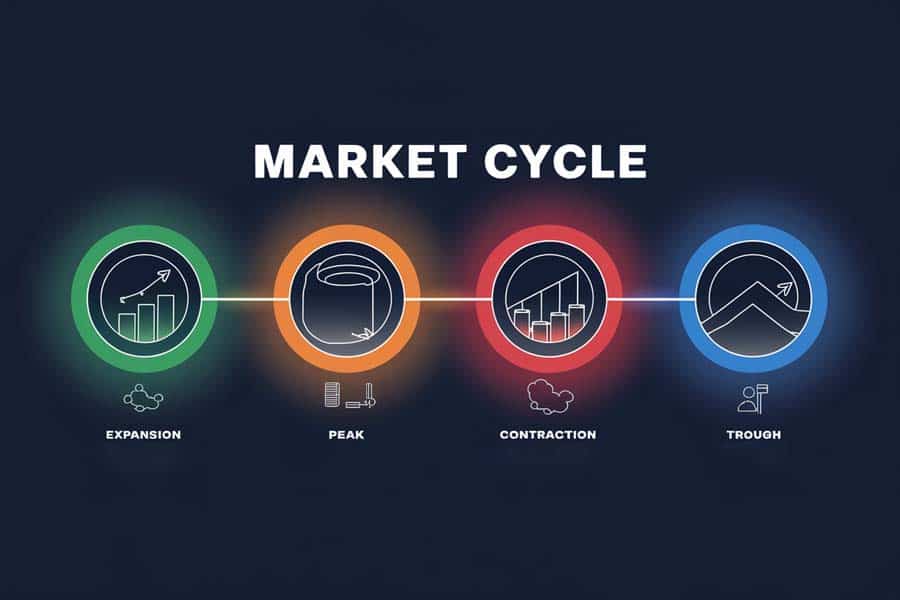
Trading is heavily influenced by market cycles, which determine when assets trend upward, decline, or move sideways. Understanding when trading decisions align with market cycles allows participants to calibrate strategies, manage risk, and exploit timing advantages. While cycles differ in duration and magnitude, they reflect patterns in macroeconomic conditions, liquidity flows, investor sentiment, and valuation levels.
The first cycle relevant to trading is the economic cycle. Expansions typically feature rising corporate earnings, accommodative monetary policy, and supportive investor sentiment. During such periods, risk assets such as equities and commodities may appreciate. Traders exploit expansion cycles by employing trend-following strategies, growth investing, or sector rotation. During recessions, corporate revenues decline, credit conditions tighten, and risk premiums rise. Traders may shift to defensive sectors, short selling, or fixed-income instruments as capital preservation becomes central.
Market cycles also reflect monetary policy cycles. Central banks influence interest rates, liquidity, and inflation expectations. When interest rates are low and liquidity is abundant, trading strategies that target speculative assets, leverage, and credit-sensitive instruments may perform well. When central banks tighten policy to combat inflation, borrowing costs rise, asset valuations compress, and volatility increases. Traders adjust exposure based on when policy pivots occur, using macro signals such as inflation data, unemployment figures, and yield curve behavior.
Sentiment cycles further influence when trading is profitable. Sentiment oscillates between fear and greed, often detached from fundamental valuations. During euphoric sentiment, asset prices may exceed intrinsic value as traders chase momentum. During fear-driven selloffs, prices may undershoot fair value as traders liquidate positions indiscriminately. Contrarian strategies attempt to exploit sentiment extremes by buying during panic and selling during exuberance, but such strategies require patience and robust risk management.
Liquidity cycles determine when trading opportunities arise. Liquidity refers to the availability of capital and willingness of market participants to take risk. When liquidity is abundant, spreads tighten and execution improves, favoring short-term trading. When liquidity contracts, spreads widen and volatility spikes, favoring traders skilled in dislocation arbitrage or volatility strategies. Institutional traders monitor funding markets, repo rates, and credit spreads to evaluate liquidity conditions.
Industry and sector cycles also influence timing. For example, commodity markets follow supply and demand cycles influenced by production capacity, geopolitical risks, and seasonal consumption. Technology sectors follow innovation cycles that determine when disruptive products gain adoption. Real estate follows property cycles driven by credit availability and demographic trends. Traders may rotate among sectors depending on where cycles favor growth or contraction.
Valuation cycles reflect when markets become expensive or cheap relative to fundamentals. Valuation metrics such as price-to-earnings ratios, credit spreads, and yield premiums indicate whether future returns may be attractive or compressed. Mean-reversion strategies exploit valuation extremes, assuming that prices revert to historical averages. However, valuation cycles can persist for long periods, requiring traders to balance patience with risk constraints.
Crisis cycles represent periods when structural shocks trigger extreme volatility. Financial crises, geopolitical conflicts, pandemics, or systemic failures create disorderly price action. During crises, traders evaluate when asset correlations converge, volatility spikes, and liquidity dries up. Some traders reduce exposure and seek safety in cash or government bonds; others target dislocation trades or volatility strategies. The challenge lies in determining when crisis conditions stabilize and when recovery begins.
Finally, innovation cycles can redefine trading paradigms. The emergence of digital assets, decentralized finance, and algorithmic platforms illustrates when technological disruptions introduce new asset classes and trading models. Traders must determine when such innovations transition from speculative experiments to mainstream adoption.
In summary, trading is driven by cycles that determine when to enter, exit, hedge, or diversify. Economic, monetary, sentiment, liquidity, sector, valuation, crisis, and innovation cycles collectively shape timing dynamics. Traders who understand when cycles shift can improve returns and reduce risk across market environments.